Build an event strategy without turning everything into events
Use events where they reduce coupling and improve reliability, not as a default integration pattern.
Quick Take
Events help when you need loose coupling, asynchronous work, or an audit trail of state changes. They fail when they become a vague replacement for clear interfaces and ownership. A good event strategy is selective: define what is worth emitting, who owns it, and how consumers handle change.
Emit events only for durable business facts
An event should represent a durable fact that matters beyond one request cycle, such as "order paid," "shipment dispatched," or "access revoked." Emitting events for transient steps like "button clicked" or "validation started" creates noise and forces consumers to infer what actually happened. A useful rule is to emit events for state transitions that would be meaningful in an audit log. If you cannot explain why the event should exist six months from now, it is probably not a system event.
Define ownership, contracts, and replay behavior up front
Event producers own the schema and the meaning. Consumers own their projections and side effects. Without this separation, teams start treating events as shared internal state and coupling increases again. Events also need operational definitions: are they at-least-once, can they arrive out of order, can they be replayed, and what does idempotency look like for consumers. If replay breaks consumers, your event stream is not a reliable integration surface.
Avoid the trap of "events instead of APIs"
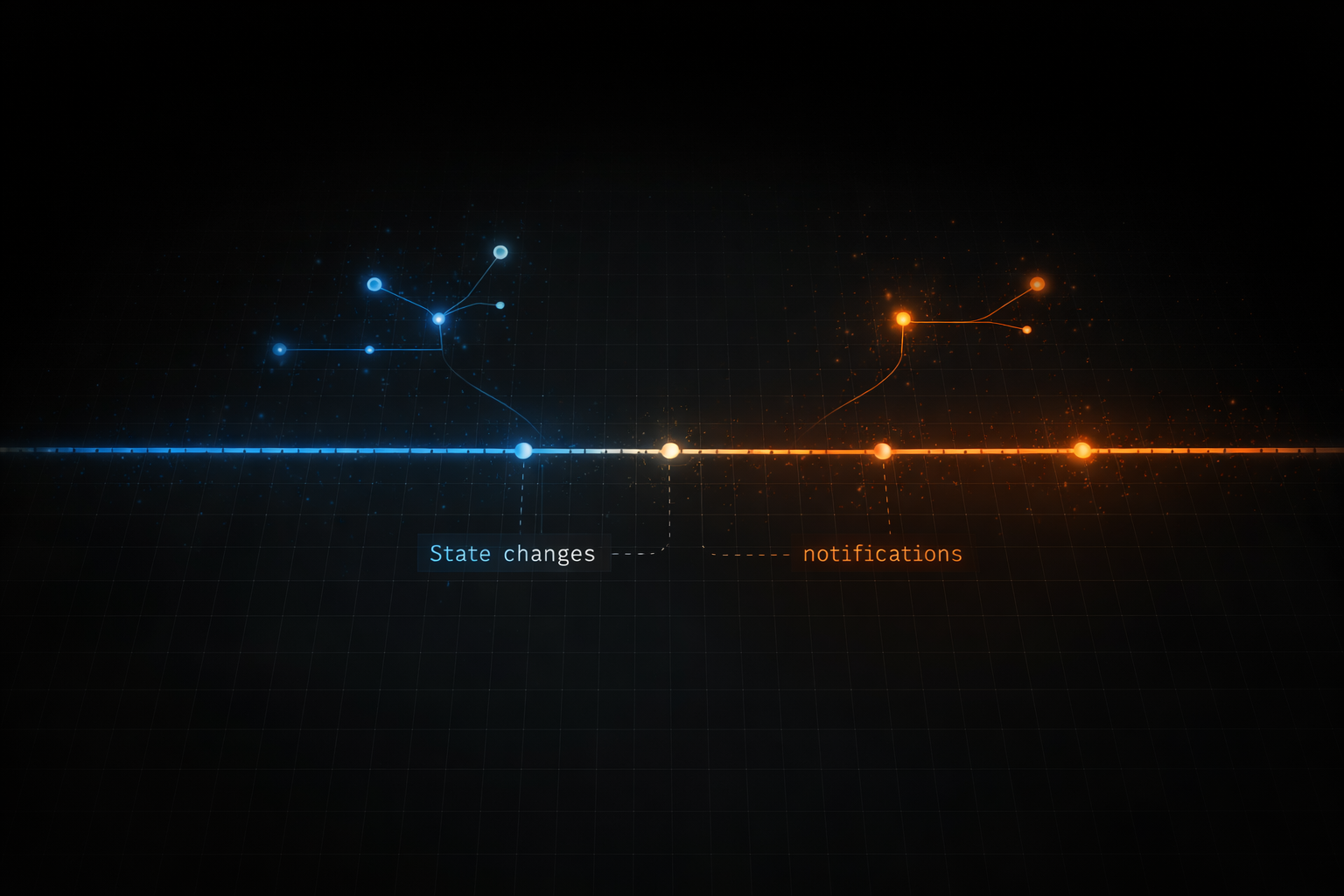
Events are good for broadcasting facts and triggering asynchronous work. They are not a great fit for workflows that require immediate answers, strict validation, or synchronous coordination. Trying to replace request-response with events often pushes orchestration into consumers and makes failure handling harder. A stable pattern is to combine both: APIs for commands and validations, events for state change notifications. This keeps intent explicit and keeps consumers from having to guess.
Signal
Most teams underestimate the cost of event evolution. If you cannot version schemas, support old consumers for a period, and define replay semantics, your "event-driven" system will quietly become fragile.