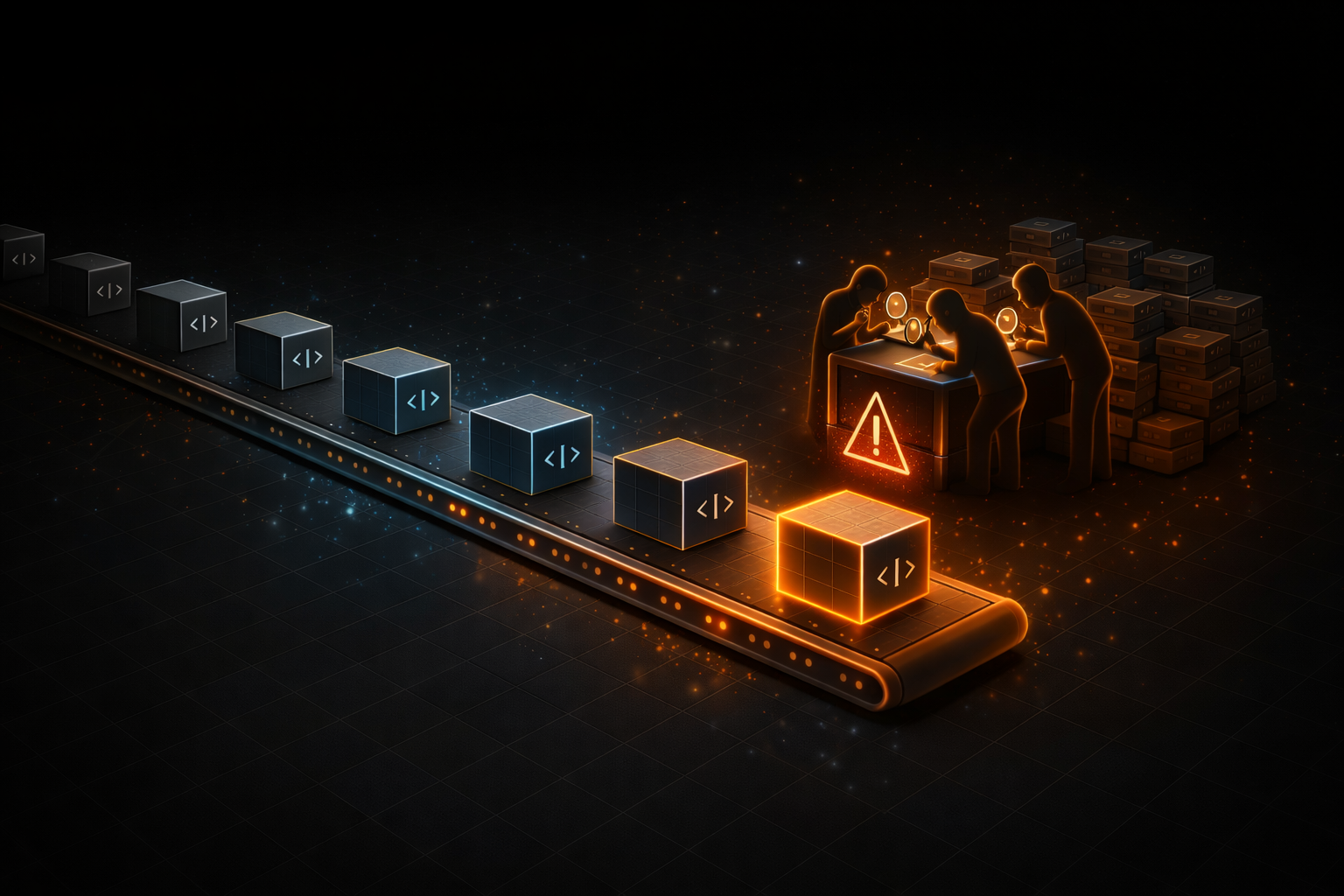
AI code assistants shift bottlenecks to architecture and review
When writing code gets cheaper, the limiting factor becomes correctness, integration, and system-level coherence.
Quick Take
AI assistants can increase code output, but that does not automatically translate to faster delivery. As generation accelerates, teams spend proportionally more time validating behavior, reviewing changes, and preventing architectural drift. Recent research and surveys show a consistent pattern: adoption is high, but confidence and speed on complex work remain constrained by verification. (Stack Overflow)
Code production is speeding up faster than verification
Code assistants mostly compress the "write" step: boilerplate, refactors, small features, and glue code become cheaper. Delivery is still a pipeline, though. Tests, review, integration, security checks, and incident readiness do not shrink just because the diff got longer. Studies and reporting increasingly describe a mismatch between perceived productivity and measured outcomes, especially for experienced developers working in real repositories where context and correctness dominate. (TechRadar)
Review and maintenance load shifts upward to core maintainers
More generated code can translate into more review surface area, more subtle defects, and more rework. A 2025 analysis of open-source projects after GitHub Copilot adoption found productivity gains driven mainly by less-experienced contributors, alongside increased rework, with the added review burden falling on core developers. (arXiv) This is the bottleneck shift in operational terms: teams move from "can we write it" to "can we safely absorb it," and the constraint concentrates on the people responsible for system integrity.
Architecture becomes the safety rail for higher-velocity change
When output increases, architecture stops being an abstract discipline and becomes the mechanism that prevents drift: duplicated patterns, inconsistent error handling, accidental coupling, and fragile integration points. The faster teams generate changes, the more they need enforceable boundaries, conventions, and automated checks to keep behavior coherent. Developer data also points to a trust boundary: tools are used widely, but complex tasks are still seen as risky. Stack Overflow's 2025 survey includes a dedicated section on how well AI tools handle complex tasks, reflecting that confidence remains uneven even as usage normalizes. (Stack Overflow)
Teams are adapting by scaling guardrails, not output
The practical response is not "ban AI" or "ship everything it writes." It's shifting effort into guardrails: stronger automated testing, clearer architectural contracts, stricter review standards, and tighter definitions of what changes are allowed to be "fast." DORA's work on generative AI in software development frames the same dynamic from a delivery perspective: AI can improve aspects of flow and productivity, but impact is mixed and dependent on the surrounding system of practices, measurement, and controls. (Google Cloud)
Signal
What most teams underestimate is verification capacity. If review discipline, automated testing, and architectural guardrails do not scale with output, AI increases apparent velocity while quietly increasing maintenance and risk. (arXiv)