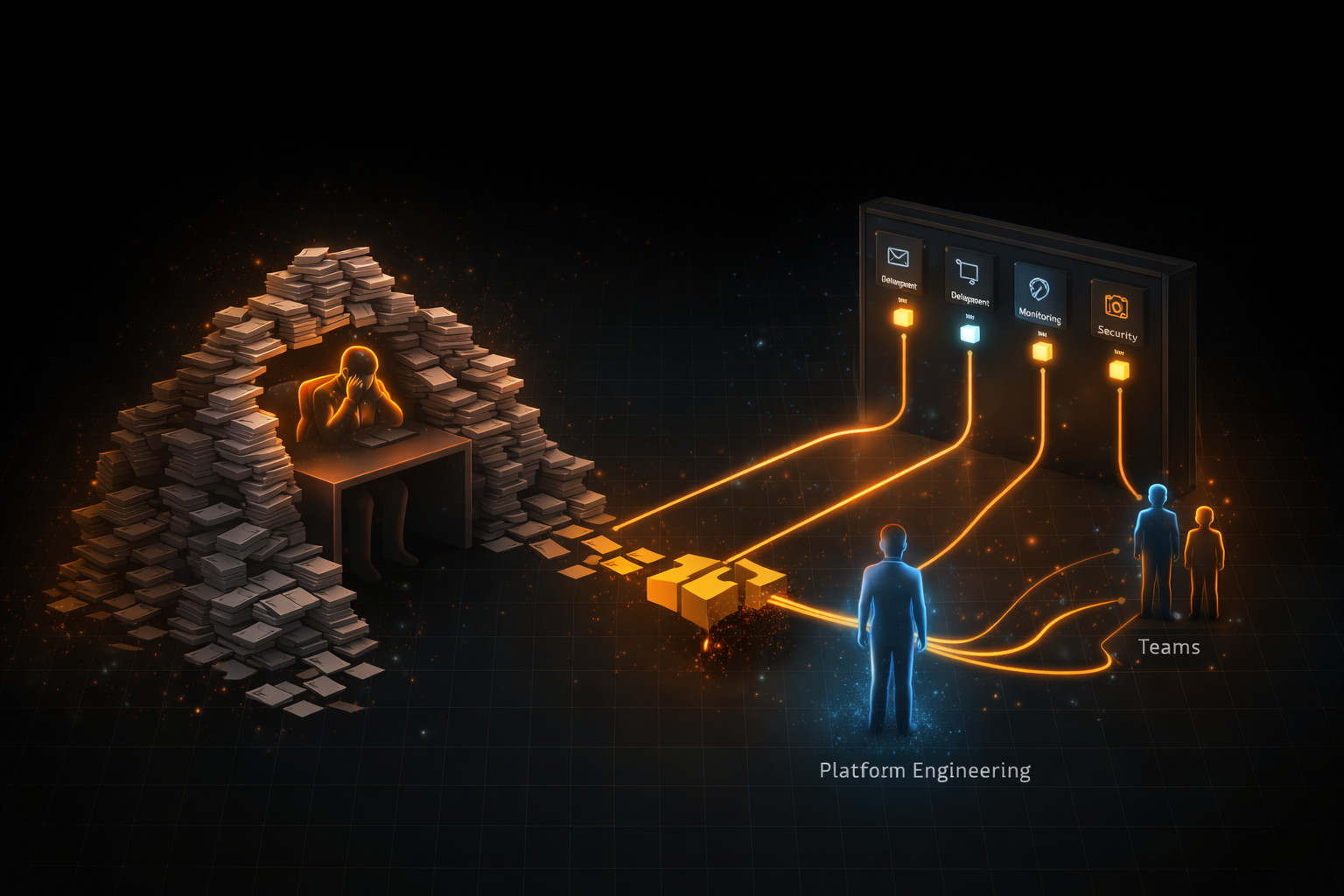
Platform engineering is replacing ad-hoc DevOps
Teams are moving from 'ticket ops' and bespoke pipelines toward internal platforms that standardize delivery through self-service.
Quick Take
DevOps practices don't fail because collaboration is bad, they fail when every team reinvents infrastructure and delivery patterns. Platform engineering shifts the center of gravity to internal developer platforms that reduce cognitive load and make common workflows self-service. The practical outcome is fewer one-off pipelines, fewer blocked teams, and clearer ownership of the delivery surface. (CNCF)
Ad-hoc DevOps hits a complexity ceiling
In many organizations, "DevOps" becomes a collection of local scripts, hand-built CI pipelines, and tribal knowledge. It works until the toolchain grows, compliance grows, and the number of teams grows. Then the same pattern turns into bottlenecks: slow provisioning, inconsistent environments, and a steady stream of tickets to a small group that "knows how it works." (CNCF) This is less a culture problem and more a systems problem. When every product team owns the entire delivery stack, you scale autonomy by scaling cognitive load and operational variance.
Platform engineering turns delivery into a product
Platform engineering formalizes the delivery layer as an internal product: a curated set of workflows, templates, and guardrails that let teams provision, deploy, roll back, and observe systems through self-service. The goal is to abstract infrastructure complexity and standardize the highest-frequency paths without forcing every team to become infrastructure experts. (CNCF) This is why internal developer platforms and portals keep showing up as the "front door" to delivery: they make discovery and self-service possible, and they create one place to embed governance and security into the default path. (CNCF)
Team shape shifts from builders of pipelines to owners of paths
In an ad-hoc model, platform capability is scattered and re-implemented. In a platform model, a dedicated group owns paved roads, scorecards, templates, and the platform lifecycle, while product teams focus on application behavior and outcomes. The boundary becomes clearer: product teams consume platform capabilities, platform teams maintain them and evolve them based on developer needs. (CNCF) This also changes what "speed" means. Faster delivery comes less from heroic CI/CD tuning and more from removing repeated decision-making and integration work across teams.
Signal
What most teams underestimate is that a platform only works if it is run like a product: clear customers (internal developers), measurable adoption, and an explicit stance on what is supported. If the platform becomes a portal on top of unchanged complexity, it will centralize pain instead of removing it. (CNCF)